
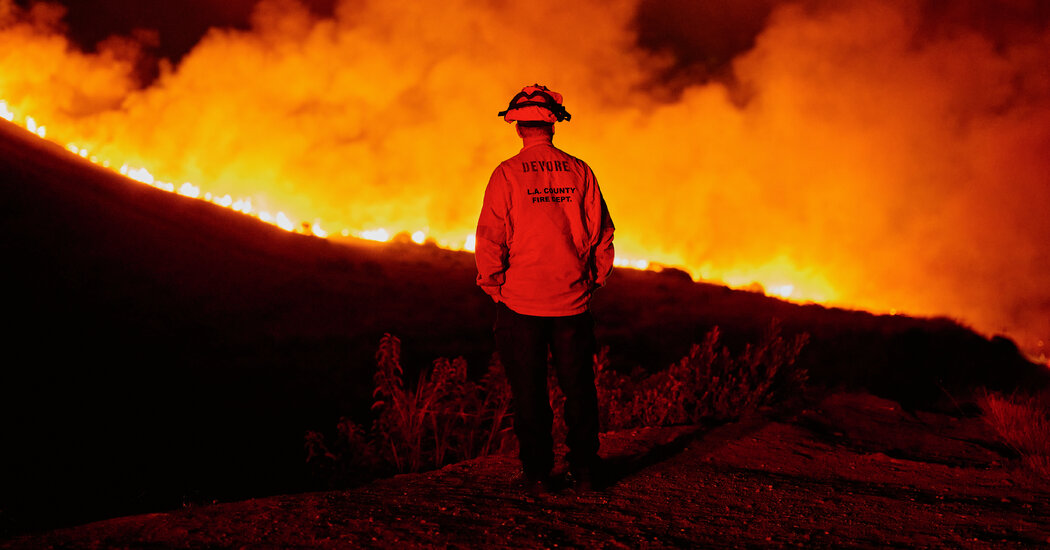
In January, hundreds of firefighters fanned across Los Angeles County to fight the Palisades and Eaton blazes as they tore through heavily populated communities, killing more than two dozen people and destroying thousands of buildings.
Days after their work, some of those firefighters had elevated levels of lead and mercury inside cells in their blood — amounts higher than those found in colleagues who had fought earlier forest fires in less populated areas.
That is an early finding from the L.A. Fire Health Study, a 10-year effort by a consortium of researchers to understand the health effects of exposure to smoke and other pollution from the recent California wildfires.
The Palisades and Eaton firefighters’ lead levels were five times higher than the forest firefighters’ levels, and their mercury levels were three times higher, said Kari Nadeau, the chair of the environmental health department at the Harvard T.H. Chan School of Public Health and one of the lead researchers on the study.
Dr. Nadeau said she had been alarmed to find that the metals had entered the firefighters’ cells, not just their blood plasma. That means the metals can come into contact with cellular DNA, potentially causing short- and long-term health consequences. Lead and mercury exposure have been associated with neurological impairments, among other problems, but how the firefighters’ specific exposures will affect them is not clear; the researchers will continue to follow them over time.
The Cedars-Sinai Medical Center is working to provide treatment to firefighters, and the researchers hope their findings could lead doctors to diagnose more people early. Quick detection of lead and mercury toxicity is key, Dr. Nadeau said. A therapy called chelation can help prevent the long-term effects, but is most effective if administered early.
The data shared by Dr. Nadeau are preliminary. They come from only 20 firefighters and have not yet been published in a peer-reviewed paper.
But Minghao Qiu, an assistant professor at Stony Brook University who has studied the health effects of wildfire smoke but was not involved in this study, said that he gave “quite some weight” to the findings. He said that they began to answer questions on which data had not been available. Previous research had measured toxins in the air, but not inside firefighters’ bodies.
Research has started to link wildfire smoke to a range of health problems. But as climate change has made wildfires more frequent, intense and widespread, evidence is emerging that the health consequences could differ in kind, not just frequency.
The finding that firefighters who fought the Palisades and Eaton blazes were affected differently than those who fought forest fires fits with existing evidence that wildfire smoke is not the same everywhere. Its contents differ based on the fuel source, the fire’s intensity and interactions with atmospheric conditions, said Michel Boudreaux, a health policy expert at the University of Maryland.
That means a fire burning buildings will produce different chemicals from a fire burning a forested area, Dr. Qiu said.
The implications of this are a subject of ongoing research. But studies on the health effects of climate change could be affected by the news this week that the National Institutes of Health may stop funding studies on the topic.
The N.I.H. is a primary source of funding for such research, though the L.A. Fire Health Study has received much of its money so far from a philanthropist.
The researchers don’t yet know what all of the long-term effects of the exposure to mercury and lead might be, nor have they finished analyzing the firefighters’ blood. They plan to continue to track the levels of lead, mercury and other toxins in the firefighters’ blood, and the trajectory of their health. The researchers and their partners are also working to track local residents’ health and to measure how well or poorly interventions like masks and household air filters protected them.
In a separate part of the study in February, researchers found elevated levels of benzene and styrene in the air even after the smoke appeared to have dissipated. Those chemicals can potentially increase the risk of cancer, lung disease, stroke and heart attacks.
Dr. Qiu said further research was needed to confirm how the lead and mercury had gotten into the firefighters’ blood. If they inhaled the chemicals through smoke while battling the fires, public health officials might make different recommendations from those they would make if the firefighters were exposed via the ash after the blazes had been put out.
“The recent findings highlight the many unrecognized cascading health effects from climate-intensified wildfire,” said Jennifer Runkle, an environmental epidemiologist at the North Carolina Institute for Climate Studies who has studied wildfire exposure but was not involved in the L.A. Fire Health Study.
Scientists already know a fair amount about short-term risks, such as that exposure to wildfire smoke is linked with asthma flare-ups. “But beyond these immediate impacts,” Dr. Runkle said, “there is a hidden human cost that we have yet to measure effectively — one that lingers beneath the surface and has long-term health consequences for both firefighters and exposed communities.”