
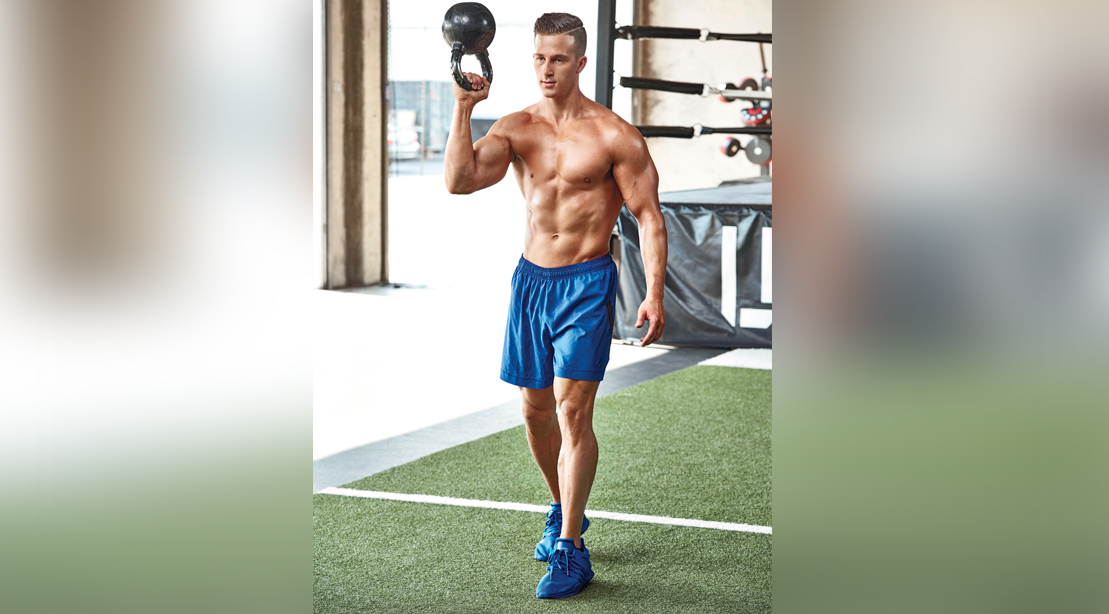
If your core training is neutral, and you need to shake things up, you’ve come to the right place. The Bottoms-Up Kettlebell Waiter’s Carry will upgrade your grip strength, shoulder stability, and core strength in a single exercise. Stabilizing an unstable load while resisting rotation while avoiding the kettlebell smashing into your forearm is challenging.
Unlike traditional carries, the bottoms-up position flips the script. The heavy end of the bell sits above the handle, demanding tension and focus with every step. This position recruits more muscle, fires up your grip and forearms, and requires your shoulders and core to work overtime.
So, if you’re ready to build a bulletproof core, improve your shoulder stability, and enhance grip strength, it’s time to take your training to the next level—bottoms-up style.
What is the Bottom-Up Waiter’s Carry?
The bottoms-up kettlebell waiter’s carry is a carry variation that adds a unique challenge to your core and upper body by flipping the kettlebell upside down—known as the bottoms-up position. This shift creates instability that forces your body to stabilize from the tips of your fingers to the soles of your feet.
You’ll carry the kettlebell at shoulder height, with the elbow bent at 90 degrees, the forearm vertical, and the wrist stacked. You then walk, keeping your core braced and your posture upright, while the bell tries to tip with every step.
How to Do The Bottoms Up Kettlebell Waiter’s Carry
The setup is vital to getting the most bang out of the bottoms-up kettlebell waiter’s carry. It’s unlike any other carry variation because it involves controlling instability through full-body tension and maintaining an upright posture under load.
Here’s how to do it right:
- Curl the bell in the bottom-up position, with your elbow bent at 90 degrees, your forearm vertical, your wrist neutral, and your hands stacked in line with the bell.
- The handle should rest firmly in the fleshy part of your palm. Then, hold on tight.
- Brace your core, glutes, and lats by lowering your rib cage and avoiding overarching your lower back.
- Walk slowly, keeping your hips level and torso upright.
- Tighten your grip and re-engage your core if the bell starts to tip or wobble.
- Switch sides and repeat once you’ve reached the required distance.
Muscles Trained
The bottoms-up kettlebell waiter’s carry may appear to be only a grip challenge, but it’s a full-body exercise that engages far more than your forearms. Here are the muscles you’re training with this terrific exercise.
Transverse Abdominis, Obliques, Erector Spinae: This is an anti-rotation and anti-lateral flexion challenge.
Rotator Cuff, Deltoids: Holding a kettlebell bottoms-up requires constant adjustments from your rotator cuff and deltoids to keep the bell balanced above your hand.
Forearms: Your forearms work overtime to crush the handle and stabilize the bell, improving grip endurance and wrist strength.
Upper Back (Trapezius and Rhomboids): Maintains the position of the shoulder blades and promotes good walking posture.
Common Mistakes and Fixes
The bottoms-up kettlebell waiter’s carry is challenging because it demands attention to detail. Here are the details to watch out for and how to ensure you’re doing it right.
Letting the Elbow Drift or Drop
Allowing the elbow to flare out or drop below shoulder height reduces tension and the likelihood of the bell crushing into your wrist.
Fix: Keep the elbow bent at 90 degrees, the forearm vertical, and the wrist neutral. Think “Stack the joints” wrist over elbow and elbow under the bell.
Overgripping
If you start too heavy or haven’t aligned the kettlebell with your wrist, you will be squeezing the life out of it, causing premature grip fatigue.
Fix: Grip firmly and aim for controlled tension—enough to stabilize the bell without burning out your forearm in the first few steps. Also, ensure your joints are stacked and the weight is not too heavy.
Losing Upright Posture
Going too heavy and pushing the envelope can result in compensation, such as slouching forward, leaning to one side, or allowing the hips to sway from one side to the other, reducing movement effectiveness.
Fix: Stand tall, engage your core, and walk with control. Every step should feel like a reset, not a walk in the park. Again, don’t be afraid to go lighter.
Letting the Bell Wobble Without Correction
When you hold a kettlebell bottom up, one thing will happen: the dreaded wobble. Rather than ignore it, adjust and react.
Fix: Treat every wobble as a cue and re-engage your grip, core, and shoulder. The bell’s feedback is your coach without the yelling in your ear.
Bottoms-Up Kettlebell Waiter’s Carry Benefits
Flipping the bell upside down unlocks benefits that affect your core, shoulders, and grip.
Develops Grip Strength
Holding the kettlebell bottoms-up forces your forearms, fingers, and wrists to work harder than a traditional grip. Because the bell is unstable, your grip strength is continuously tested.
Boosts Shoulder Strength
The bottoms-up position requires constant micro-corrections from the rotator cuff and deltoid muscles. If you’ve struggled with shoulder strength or are returning from an injury, this carry provides a way to build strength without heavy loading.
Enhances Anti-Rotation Strength
Since the load is held unilaterally and high on the body, your core must resist rotation and lateral flexion with every step. This builds functional core strength that carries over to big compound lifts and daily movements.
Improves Posture
Walking with an unstable load requires staying upright, tall, and aligned. If you lose the upright position, the bell will let you know. Over time, this carry reinforces strong postural habits and teaches you how it feels to create full-body tension from head to toe.
Bottoms-Up Kettlebell Waiter’s Carry Workout Programming Suggestions
Begin with a light kettlebell, between 10kg and 16kg (18 to 35 pounds), depending on your strength and experience. Trust us, you’ll be surprised at how hard it is even with modest weight.
- Beginner: 2–3 sets, 15-25 yards on each side.
- Intermediate to Advanced: 2-3 sets, 25-40 yards on each side.