

What goes in must come out — and that’s exactly why your poop can help you dial in your healthiest diet. Fecal color, consistency, and frequency can act as a nutrition meter.
“When you’re eating right for you, your body produces good poops,” says Todd Sinett, D.C., founder of Tru Whole Care in New York City and author of The Good Sh*t.
Here, experts share what your poop health, color, frequency, and consistency say strictly about the food on your plate. Health conditions can also affect poop health and quality, so if you’re concerned about something more serious, consult a physician.
Poop Color
Food coloring can dye your doo-doo just about any color of the rainbow. But if there haven’t been any blue icings or black licorice in your diet recently, here’s what each color may signal about your intake.
What does brown poop mean?
Brown bodes well for your poop health and diet. The exact shade reflects GI transit time.
“Stool that moves through quickly can be lighter in color while stool that sits in your colon develops a darker color,” says Bethany Doerfler, R.D.N., a gastrointestinal research specialist with the Northwestern Medicine Digestive Health Center in Chicago. If you have significantly dark or light poops, read on to learn which foods could speed up or slow things down.
What does green poop mean?
Lettuce guess: You’ve been eating your greens? Green veggies, especially dark leafy ones that are rich in the pigment chlorophyll, can color your poop green, Sinett says. However, green stools can also occur when foods move too quickly through your GI tract (a.k.a. diarrhea). If that sounds familiar, check up on frequency below.
What does red poop mean?
Beets are famous for turning stools alarmingly red, but other naturally red-hued foods can blush your bowel movements as well, Doerfler says. If you haven’t had any red foods lately, talk to your doctor about underlying health conditions.
What does black poop mean?
Are you taking iron supplements? Because they can turn poop a scary black color, as can Pepto-Bismol. But frequently requiring GI-targeted medicines is a big clue something might be off in your diet.
What does orange poop mean?
Beta carotene, the orange pigment that gives carrots their color, can theoretically give your poop an orange tinge. It’s more likely to occur with carrot juice as opposed the whole vegetable; you’d have to eat an inhuman amount of carrots to color your stool.
What does yellow poop mean?
“Pale yellow stools can be a sign that you have rapidly moving bowels,” Doerfler says. “This could be very normal and due to a high-fiber diet.”
Poop Frequency and Consistency
“Consistency and frequency of bowel movements matter,” Doerfler says. And they tend to be related. When food moves too fast through your digestive tract, it comes out watery. If fecal matter stalls, rock-hard constipation can result.
That said, there’s no one perfect poop timing that signals dietary perfection.Everyone has their own unique schedule, with anything from three times per day to three times per week being considered normal, Sinett says.
If you have to go more or less frequently, or you notice any changes in your schedule, you may be dealing with diarrhea or constipation.
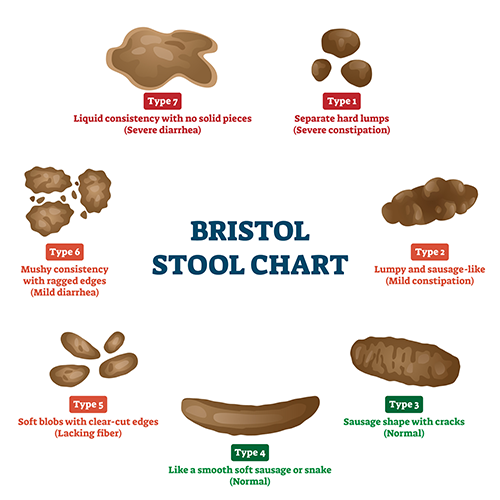
The Bristol scale categorizes stool by seven types:
- Type 1: Separate, hard lumps
- Type 2: Sausage-shaped, lumpy
- Type 3: Sausage-shaped, cracked on surface
- Type 4: Sausage- or snake-shaped, smooth and soft
- Type 5: Soft blobs, clear-cut edges
- Type 6: Mushy pieces, ragged edges
- Type 7: Entirely liquid, no solid pieces
Types 1 and 2: Constipation
If you have hard and dry pellets, you’re likely not getting enough soluble fiber. Soluble fiber increases water content of your stool to improve poop health and keep things moving, Doerfler says. If you’re dealing with constipation, try consuming between two and four servings of fruit daily.
Berries, fresh pears, and kiwis are all exceptionally helpful at easing constipation. It’s also possible that you’re not getting enough fluids each day, so check your pee color. A straw or pale yellow color is your goal.
Types 3 and 4: Normal
Congrats! This is the consistency you’re going for. When you’re eating a wide array of nutrients, meeting your fiber needs, and avoiding any foods that aggravate your GI tract, the vast majority of your daily bowel movements will fall in this category, Sinett says.
Food chunks
“Seeing undigested foods in your stool is normal,” Doerfler says. “It simply means you didn’t break down the fibers fully.”
Types 5 to 7: Diarrhea
So many foods and dietary habits can cause diarrhea. These include caffeine, alcohol, spicy foods, and calorie-free sweeteners such as sorbitol, mannitol, and xylitol, Doerfler says.
Diarrhea can also occur when overall fiber content is lacking. “Fiber can be used to bulk up the stool and make it thicker,” Doerfler says.
Lastly, it’s possible that you’re intolerant of one or more of the foods that you’re eating.
Greasy floaters
“Fat in your stool is typically not normal unless you’re eating close to 100 grams of fat daily,” Doerfler says. That is certainly possible if you’re following a ketogenic diet, but if your fat intake is not that extreme, talk to your doctor about potential causes of malabsorption.
Tracking Your Poop
“I love when my patients track their food intake,” Doerfler says. Simply noting what goes in and what goes out throughout the course of each day and week can provide you a lot of valuable information as to what agrees and wholeheartedly disagrees with your system.
Before making any radical changes to your diet, such as removing an entire food group, talk to your doctor, a gastroenterologist, or a registered dietitian to ensure that you’re still getting the nutrients you need.
“If you notice a clear pattern of eating and altered bowel symptoms such as worsening bloating or loose stools, discuss these patterns with your doctor or dietitian to develop a game plan,” she says.
Also, when evaluating the effects of different foods on your poop health, pay attention not just to what you see, but what you feel, Sinett says. Ideally, you should feel relief after each poop. Lingering pain, discomfort, or bloating all signal GI distress.