
Given the rise in brain-based conditions and the growing development and investment in neurotechnologies to target them, it is important to understand how the public views these interventions and whether they would be willing to use them.
To explore this, researchers conducted a survey of over 1,000 U.S. adults to examine perceptions of four neurotechnologies designed to treat severe mood, memory, or motor symptoms. The work is published in the journal Device.
One of the goals of the recently created Neurotech Justice Accelerator at Mass General Brigham (NJAM), a Dana Center for Neuroscience & Society, is to better understand public views about emerging neurotechnologies.
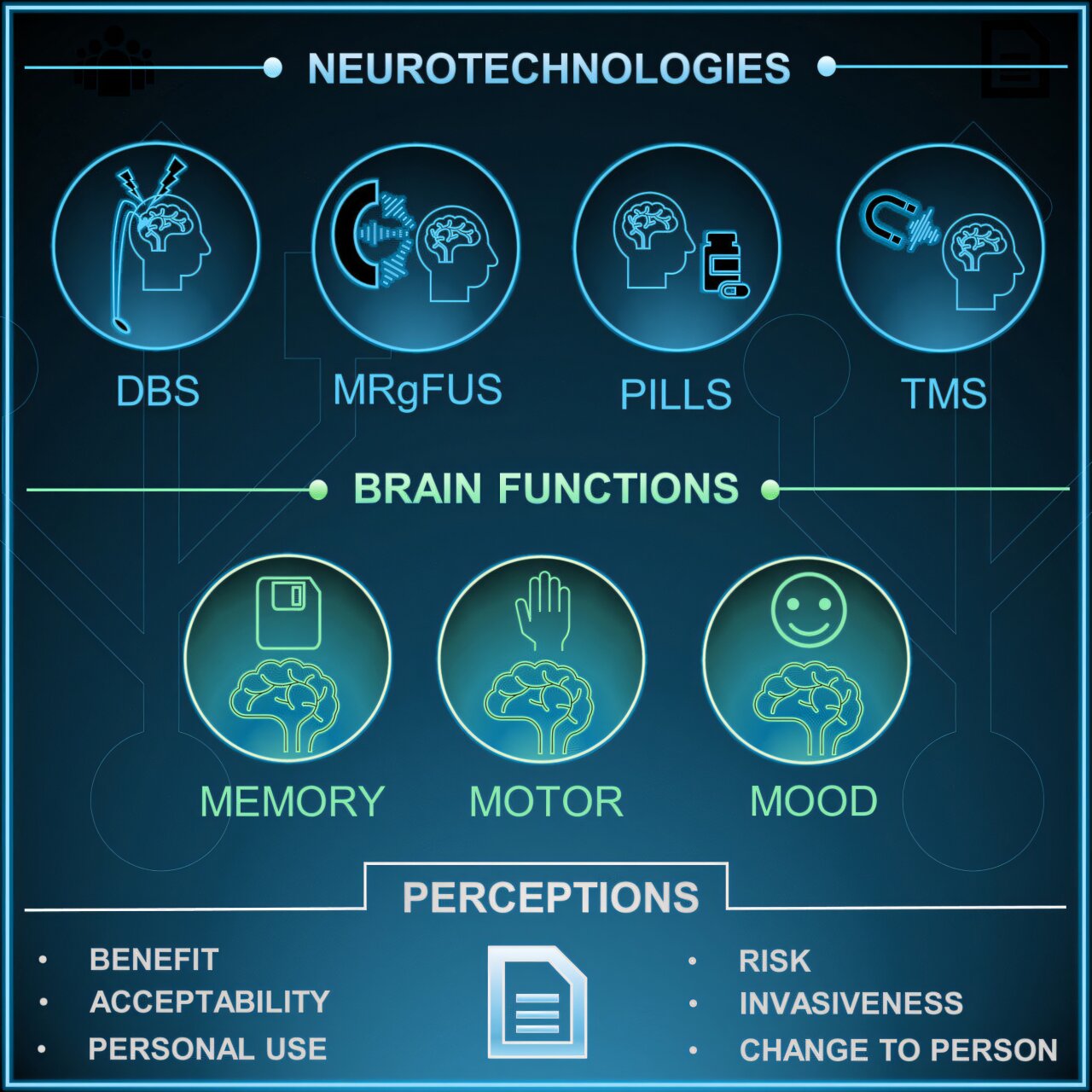
While prior research has typically examined only one technology at a time, this study allowed for direct comparisons across four neurotechnologies: deep brain stimulation (DBS), MRI-guided focused ultrasound (MRgFUS), transcranial magnetic stimulation (TMS), and pills.
DBS is a surgical procedure in which electrodes are implanted in the brain. MRgFUS is a non-invasive treatment (sometimes called “incisionless surgery”) that uses high-frequency sound waves to target brain tissue. TMS is a non-surgical procedure that uses magnetic pulses to stimulate nerve cells.
The team also experimentally varied the symptoms, randomly assigning participants to consider these technologies in targeting either severe mood, memory, or motor impairments. This design allowed them to further examine how symptom type might influence public perceptions of these neurotechnologies. The findings offer new insights into how people weigh intervention options depending on the condition being addressed.
For each neurotechnology, participants rated how beneficial, acceptable, and risky they perceived it to be, whether they thought it might change who someone is as a person, and how likely they would be to consider using it themselves if they experienced one of those symptoms.
While familiarity with these neurotechnologies was generally low (except for pills), there was some openness to consider them in cases with severe symptoms. Likelihood of use varied, with 61% of participants open to considering pills, 41% for TMS, 29% for MRgFUS, and 21% for DBS.
Pills were rated as the most beneficial, acceptable and most likely to be used.
In contrast, deep brain stimulation (DBS) was seen as the second most beneficial but also the riskiest, most invasive, and least likely to be used. This finding suggests that even when participants recognize certain interventions as potentially beneficial, concerns about invasiveness and a change to a person’s self might lead to hesitation.
Notably, the type of symptom the neurotechnologies were meant to target also had a major impact on perceptions.
Participants viewed modulation for motor symptoms as significantly more acceptable and beneficial than those for mood symptoms, which were also seen as more invasive and more likely to change who someone is.
These findings suggest that people are not only concerned about the procedures themselves but also about the nature of the symptoms being treated, which reflects deeper beliefs about mental versus physical illness. Understanding these distinctions is essential for improving communication and guiding the ethical implementation of neurotechnologies.
By examining how people perceive neurotechnologies and the brain-based conditions they aim to treat, researchers gain insight into which factors shape public attitudes and whether these views align with current clinical practices and available neurotechnological intervention options.
The findings provide a baseline for future research on how framing and education may shape public and patient attitudes toward brain-based interventions.
They can also inform device developers about which forms of neuromodulation are viewed as more acceptable and guide more responsive design. And for clinicians, the results provide a window into public and potential patients’ expectations, which can support more effective communication about the risks and benefits of available interventions.
The current results show that people distinguish between four neurotechnologies in terms of perceived risk, benefit, acceptability, invasiveness, and perceived change to self. These differences reveal key barriers and facilitators to public uptake. Yet perceptions such as risk and benefit don’t operate in isolation, they are part of a broader belief system.
Next, to build on these findings, the researchers plan to use network analyses to examine how these perceptions are interrelated and how their combined influence impacts openness to neurotechnology use, which will support the ethical development and communication of neurotechnologies that better reflect patient values and needs.
More information:
Rémy A. Furrer et al, Public perceptions of neurotechnologies used to target mood, memory, and motor symptoms, Device (2025). DOI: 10.1016/j.device.2025.100804
Citation:
Study provides a window into public perceptions about technological treatment options for brain conditions (2025, May 26)
retrieved 26 May 2025
from https://medicalxpress.com/news/2025-05-window-perceptions-technological-treatment-options.html
This document is subject to copyright. Apart from any fair dealing for the purpose of private study or research, no
part may be reproduced without the written permission. The content is provided for information purposes only.