
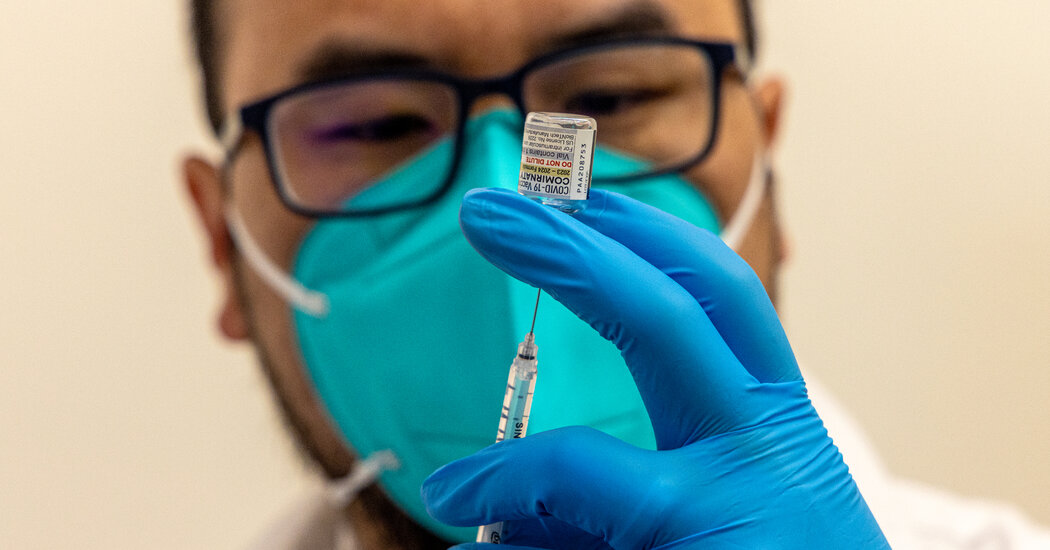
Health Secretary Robert F. Kennedy, Jr., has repeatedly questioned the safety of mRNA vaccines against Covid-19. Scientists with funding from the National Institutes of Health were advised to scrub their grants of any reference to mRNA. Around the country, state legislatures are considering bills to ban or limit such vaccines, with one describing them as weapons of mass destruction.
While mRNA, or messenger RNA, has received widespread attention in recent years, scientists first discovered it in 1961. They have been studying it and exploring its promise in preventing infectious diseases and treating cancer and rare diseases ever since.
What is mRNA?
A large molecule found in all of our cells, mRNA is used to make every protein that our DNA directs our bodies to build. It does so by carrying information from DNA in the nucleus out to a cell’s protein-making machinery. A single mRNA molecule can be used to make many copies of a protein, but it is naturally programmed to die eventually, said Jeff Coller, a professor of RNA biology and therapeutics at Johns Hopkins University and a co-founder of an RNA therapeutics company.
How do mRNA vaccines work?
Right now, there are three FDA-approved vaccines available that use mRNA, two for Covid-19 and one for R.S.V., or respiratory syncytial virus, in older adults. These vaccines consist of strands of mRNA that code for specific viral proteins.
Say you get a Covid-19 vaccine. The strands of mRNA, packaged into tiny fat particles, go into your muscle and immune cells, said Robert Alexander Wesselhoeft, director of RNA therapeutics at the Gene and Cell Therapy Institute at Mass General Brigham. Protein factories in the cells then take instructions from the mRNA and manufacture a protein like the one found on the surface of a Covid-19 virus. Your body recognizes that protein as foreign, and mounts an immune response.
Most of the mRNA will be gone within a few days, but the body retains a “memory” of it in the form of antibodies, Dr. Coller said. As with other types of vaccines, immunity wanes both over time and as a virus evolves into new variants.
Why are mRNA vaccines being used now?
In the mid-2000s, scientists at the University of Pennsylvania figured out how to get foreign mRNA into human cells without it degrading first. That enabled researchers to develop it for use in vaccines.
The main use for such vaccines right now is to prevent infectious diseases, like Covid-19 and R.S.V., said Dr. Wesselhoeft, who founded a company that develops RNA therapies. The mRNA vaccines can be made very quickly because all of the components, other than the RNA sequence, remain the same across different vaccines.
This feature could be helpful for developing the annual flu vaccine, said Florian Krammer, a virologist at the Icahn School of Medicine at Mount Sinai, who has previously consulted for Pfizer and CureVac on mRNA therapies. Typically, scientists decide in February or March which influenza virus strains to include in a vaccine that will be rolled out in the United States in September. But by that time, a different strain may be dominant. Because an mRNA vaccine can be manufactured more quickly than the current flu shot, scientists could wait until May or June to see which strains are circulating, Dr. Krammer said, increasing the likelihood the vaccine will be effective.
Do these vaccines have risks?
A common question patients ask is whether an mRNA vaccine can affect their DNA, Dr. Boucher said. The answer is no. Our cells cannot convert mRNA into DNA, which means that it can’t be incorporated into our genome.
The vaccine for Covid-19 can cause muscle aches and flulike symptoms, but these are expected side effects for vaccines generally, Dr. Krammer said.
It’s been more than four years since the Covid-19 vaccine was first rolled out “and there are not long-term safety signals,” said Dr. Adam Ratner, a pediatric infectious disease specialist in New York. Many parents were concerned about myocarditis, an inflammation of the heart muscle that was reported as a possible side effect of the vaccine. But, Dr. Ratner said, the risk of such inflammation from an actual Covid-19 infection, or of long Covid or multisystem inflammatory syndrome in children, was far greater.
What else can mRNA be used for?
Vaccines using mRNA are currently being studied for a wide range of diseases, including cancer, cardiovascular disease, autoimmune disorders like Type 1 diabetes and rare diseases like cystic fibrosis, a genetic condition that results in excessively thick, sticky mucus that can plug the airways and damage the lungs.
In cancer, the idea is that the mRNA codes for a tumor protein that the immune system will recognize as foreign, telling the body to attack the tumor. In a genetic disorder like cystic fibrosis, it codes for a functioning version of a deficient protein to replace the faulty one and restore the mucus to healthy state.
A paper in the journal Nature earlier this year showed that an experimental mRNA vaccine for pancreatic cancer provoked an immune response in some patients after they had undergone surgery for the cancer. Patients who experienced that immune response lived longer without cancer than patients who did not.
Another recent paper showed that, in monkeys, an inhaled mRNA therapy could produce a protein needed to form cilia, the hairlike structures that line our airways and move mucus out of them. These proteins malfunction in a debilitating respiratory disorder called primary ciliary dyskinesia.
This research is still in early stages: The pancreatic cancer study, a Phase I trial, included only 16 patients, and there may have been other differences between the two groups that accounted for the different survival times. There is a long history of research showing that interventions may lead to immune responses without actually changing patients’ outcomes, explained Dr. Steven Rosenberg, chief of the surgery branch at the National Cancer Institute and an expert in cancer immunotherapy.
Dr. Richard Boucher, a pulmonologist at the University of North Carolina at Chapel Hill, noted that for lung diseases, it’s extremely difficult to safely get the particles carrying mRNA into exactly the right cells.
In general, Dr. Ratner said, mRNA vaccines are “exciting” in that they offer hope for disease treatments where prior technologies have failed. But mRNA therapy is still a drug technology like any other: In some diseases it likely will work, he said, “and in other cases it probably won’t.”